


Using a Hydraulic Breaker for Demolition: Where It Works Best and How to Get the Best Results
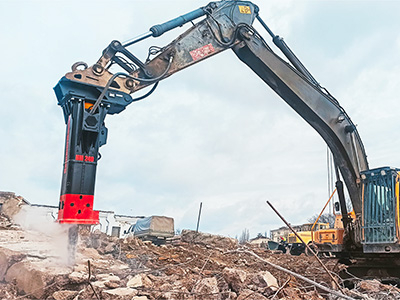
A hydraulic breaker (hydraulic hammer) is one of the most powerful and practical tools in modern demolition. It’s used when manual methods are too slow, and blasting is either inappropriate or not allowed. Thanks to controlled impact force, a breaker can quickly fracture concrete, reinforced concrete, stone, asphalt, and other hard materials while keeping the process manageable and reducing risks to nearby structures.
Where a hydraulic breaker is used in demolition
Most commonly, a hydraulic breaker is mounted on an excavator, mini excavator, or loader and is used for tasks such as:
- Breaking concrete foundations and floor slabs (including thick monolithic concrete).
- Demolishing reinforced concrete elements: beams, columns, retaining walls, and structural frames.
- Removing asphalt and road surfaces during reconstruction or utility replacement.
- Creating openings in concrete for lifts, stair cores, and engineering systems.
- Splitting masonry and boulders on sites, in pits, and during base preparation.
- Pre-demolition “loosening” to prepare structures for further dismantling.
Why a hydraulic breaker often beats handheld jackhammers and cutting
Compared to handheld breakers, a hydraulic hammer can deliver a major productivity boost: fewer workers on site, faster progress, and more consistent results on hard materials. Compared to diamond cutting, it’s a rougher method—but often far more cost-effective for bulk breaking when you don’t need perfectly straight edges.
Key advantages:
- High-speed demolition of large volumes.
- Access to difficult areas (pits, basements, restricted sites—when the right machine size is chosen).
- Better control: work is performed in stages, limiting unintended damage.
- Economics: lower cost per m³/ton in many scenarios versus heavy manual labor combined with cutting.
How to choose the right hydraulic breaker for the job
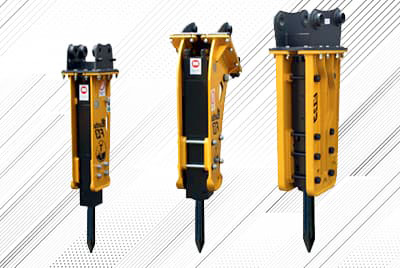 Efficiency is not only about “how hard it hits”. The following parameters matter:
- Carrier size and class (mini excavator, 10–20 t, 25+ t).
- Impact energy and blow rate (different materials need different balance).
- Tool type (moil point / chisel / blunt) depending on asphalt, concrete, or stone.
- Access and logistics: machine entry, debris handling, space for stockpiling and sorting.
A practical rule: thick reinforced concrete and foundations typically require a heavier breaker class, while tight spaces demand compactness and precision—even if overall production is lower.
Demolition technique: how to break without causing unnecessary damage
To keep breaking fast and safe, demolition is done step by step:
- Assess the structure (thickness, reinforcement, voids, concrete condition).
- Mark out zones and define a breaking sequence (direction, stages, priorities).
- Relieve edges/joints, then break the mass into controllable fragments.
- Sort debris (concrete, metal, brick) and prepare it for hauling/recycling.
Important: excessive impacts in one spot can create unwanted cracking in adjacent elements. That’s why skilled operators work in controlled bursts and move systematically, monitoring crack development and fragment size.
Safety and limitations
A hydraulic breaker generates vibration, noise, and dust, so the following are essential:
- a safety exclusion zone (risk of flying debris);
- dust suppression (wetting, localized water supply);
- vibration impact control near buildings and utilities;
- PPE for personnel (eye/face protection, helmet, hearing protection, respirator).
In dense urban areas, breakers are often combined with diamond cutting: cutting sets clean boundaries, and the breaker removes the bulk—reducing risk and improving accuracy.
What affects the cost of demolition with a hydraulic breaker
Pricing typically depends on:
- material strength and thickness, and the amount of reinforcement;
- site accessibility and machine entry;
- loading/hauling requirements and disposal or recycling;
- operational constraints (time windows, noise rules, proximity to structures).
When a hydraulic breaker is the best option
A hydraulic breaker is ideal for foundations, monolithic slabs, road surfaces, massive concrete elements, and preparatory breaking before dismantling. If you need fast, controlled concrete demolition, this method often delivers the best balance of cost and productivity.
FAQ
Can a hydraulic breaker demolish reinforced concrete?
Yes, but productivity depends on reinforcement diameter and density. Additional rebar cutting may be required.
How messy is it?
There will be dust and fragments, but these are manageable with wetting, barriers, and proper hauling logistics.
Can you work close to a building?
Yes, but vibration and cracking risks must be assessed. In some cases, combining with diamond cutting or using a smaller breaker class is safer.