


Concrete Crushers (Hydraulic Concrete Shears) for Demolition: Where They’re Most Effective and How to Get Maximum Results
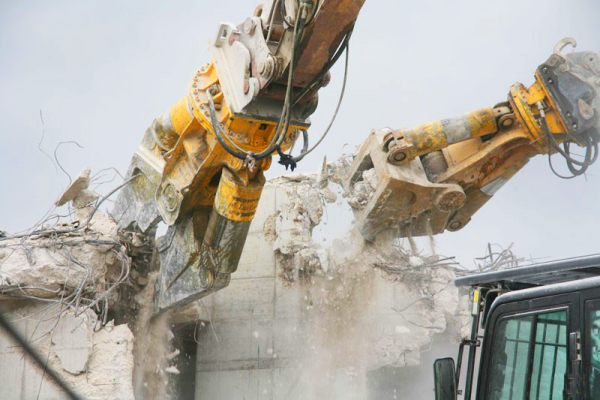
Concrete crushers (often called hydraulic concrete shears, concrete pulverizers, or simply crushers) are excavator attachments that don’t “hit” like a breaker — they crush and bite through concrete, breaking a structure into controlled fragments. In demolition, they are one of the most practical tools when you need precision, safety near existing buildings, and reduced vibration compared to a hydraulic breaker.
Where concrete crushers are used in demolition
Concrete crushers are most effective wherever reinforced concrete must be dismantled step-by-step and with control:
- Dismantling RC columns, beams, girders, and stair flights.
- Demolition of cast-in-place walls, shear walls, and diaphragms.
- Breaking down floor slabs (often after dividing them into manageable sections if needed).
- Removing foundations and grade beams with controlled break patterns.
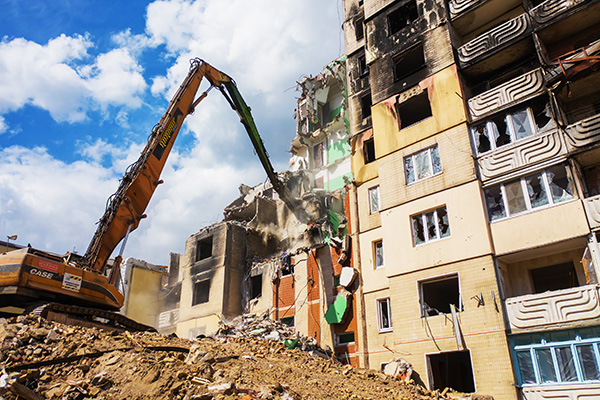
- Work in dense urban areas near residential buildings, utilities, and operating facilities.
- On-site material separation: concrete rubble separately, rebar separately — ready for hauling or recycling.
Why a concrete crusher is often better than a hydraulic breaker
A hydraulic breaker is great for fast bulk removal, but it produces impact, noise, and vibration. A concrete crusher works by compression, which usually means better control and fewer side effects.
Key advantages of concrete crushers:
- Lower vibration — safer near adjacent structures and facades.
- Less noise (compared to impact demolition) — easier to comply with time restrictions.
- More controlled demolition: easier to reduce elements into fragments of the required size.
- Better material separation: simpler to separate concrete from rebar and reduce mixed waste.
- Safer at critical points — near openings, load paths, and sensitive utilities.
Types of concrete crusher attachments
The term “crusher” may refer to different jaw attachments. Choosing the right type matters:
- Pulverizers — crush concrete and clean it off rebar during secondary demolition and processing.
- Concrete crushers — heavy jaws that “bite” through walls, beams, columns, and monolithic concrete.
- Combination jaws — can handle some rebar depending on the model, but always have limits by bar diameter and steel grade.
How to choose the right concrete crusher for the job
 Performance is not only about “power”. The excavator and attachment must match the task:
- Excavator class: mini, 10–20 t, 25+ t — thicker RC requires more machine mass and hydraulic flow.
- Jaw opening and geometry: the ability to grip and fracture the element from the correct side.
- Crushing force and cycle time: for tough RC, “slower but stronger” often wins.
- Rotator (rotating head): dramatically improves positioning speed and precision on complex nodes.
- Rebar density: plan how rebar will be cut/handled (separate attachment or cutting method).
Practical rule: if you need accurate reinforced-concrete demolition in urban conditions, the crusher often wins. If you need to “move volume” on thick monolith without strict cleanliness requirements, a breaker (or “saw-cut + breaker”) can be faster.
Demolition technique: how crushers work safely and efficiently
To keep demolition predictable and productive, crews follow a step-by-step approach:
- Assess the structure: thickness, concrete strength, reinforcement layout, and any prestressed elements.
- Plan the sequence: what comes off first, what carries load, and where controlled fracture zones are.
- Work from edges and joints: weaken connections first, then break the mass into manageable fragments.
- Separate materials: concrete rubble apart, rebar apart — prepare for hauling or recycling.
Important: Crushers are most effective when you “break” elements where fracture is predictable. Skilled operators control the direction of failure and avoid uncontrolled tearing and large drops.
Best combinations with other methods
- Diamond cutting defines clean boundaries, and the crusher removes the mass quickly without impact.
- Hydraulic breaker can open extremely dense areas, while the crusher finishes and separates materials.
- Steel shears or cutting methods handle large-diameter rebar and steel structures.
Safety and limitations
Even with lower vibration, risks remain: falling fragments, small flying debris, and dust.
- Fence off the work zone and control access.
- Dust suppression: water spray or local water feed.
- Structural stability control: never remove “supports” without a proper plan and staging.
- PPE: hard hat, eye/face protection, hearing protection, gloves, and a respirator.
What affects the cost of crusher demolition
- Concrete thickness/strength and reinforcement density.
- Site access (approach, height, tight spaces, time restrictions).
- Need for rebar cutting and extra operations.
- Sorting, loading, hauling, disposal, and recycling.
- Required level of “cleanliness” and precision (often paired with diamond cutting, smaller fragments, etc.).
When a concrete crusher is the best solution
Concrete crushers are ideal for reinforced-concrete demolition in urban conditions, where controlled dismantling, safety near intact structures, and easy material separation matter. If you need controlled concrete demolition, a crusher often delivers the best balance of precision and productivity compared to impact-based methods.
FAQ
Can crushers handle heavily reinforced concrete?
Yes, but productivity depends on the reinforcement layout. Large-diameter rebar often requires separate cutting or a combined solution.
Which produces less vibration: a breaker or a crusher?
Typically, a crusher produces less vibration because it destroys by compression rather than impact.
How precise is this method?
It’s highly controllable and allows predictable fragment sizing. For clean borders, it’s often combined with diamond cutting.
Can you work next to residential buildings?
Yes, that’s a common use case, but you still need risk assessment, fencing, and structural stability control.